A worktop in a family kitchen takes more punishment than almost any other surface in the home. Hot pans, sharp knives, spills, school bags dropped on the counter, and the general wear of daily life all make their mark. Choosing the right material is therefore one of the most important decisions in a kitchen project, and one that deserves careful consideration rather than a purely aesthetic choice.
The following guide covers the main materials available and how they perform in a busy family environment, drawing on the experience of our design team at Ornate Kitchens.
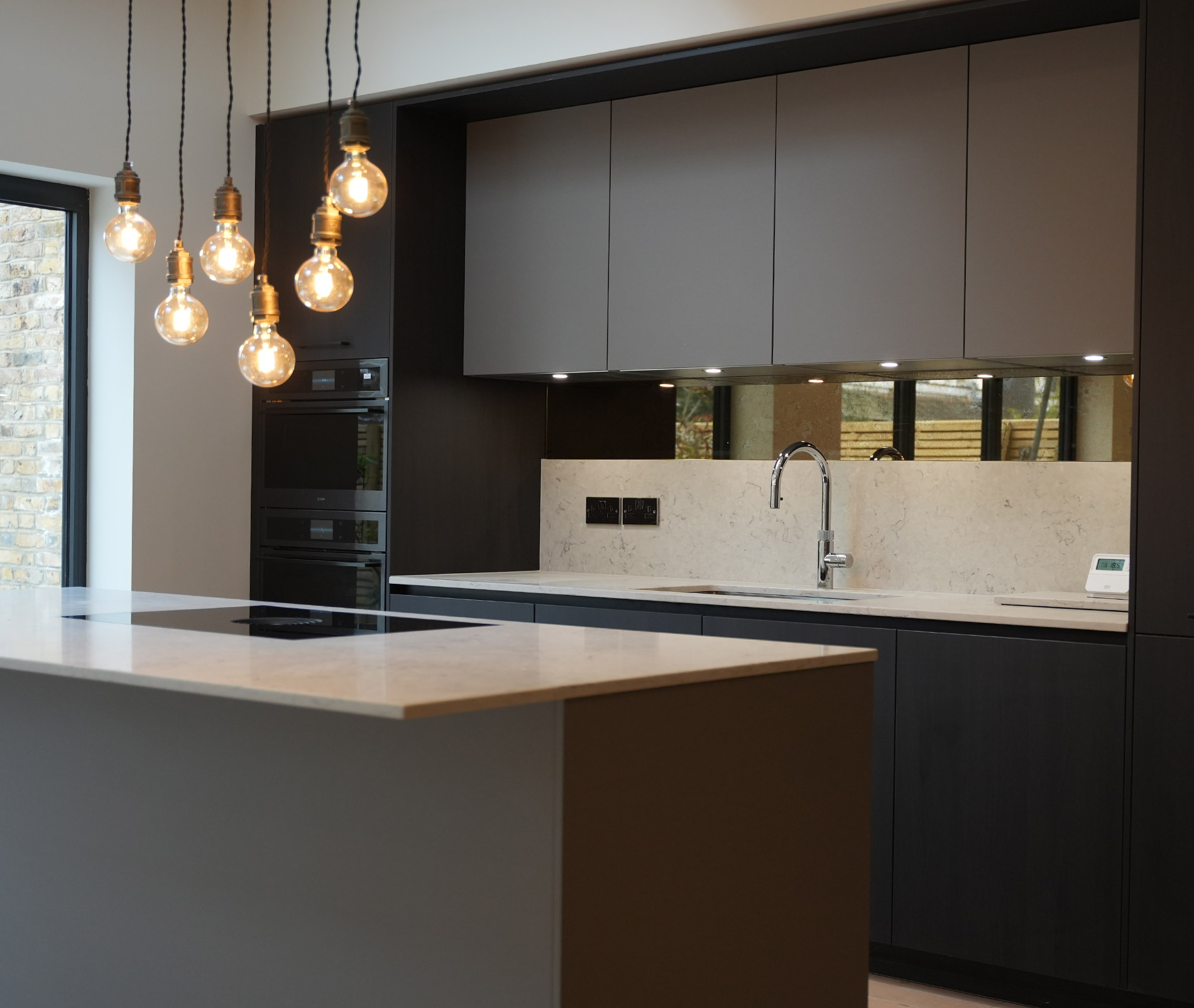
QUARTZ: THE PRACTICAL FIRST CHOICE
Engineered quartz has become the most popular worktop material in the family kitchen market, and for good reason. It is non-porous, which means it does not stain or harbour bacteria in the way that natural stone can. It is highly resistant to scratching and impact. It requires virtually no maintenance beyond wiping down with a damp cloth. And it is available in an exceptionally wide range of colours and finishes, from clean whites and light greys to deep charcoals and subtle marble effects.
The main limitation of quartz is heat resistance. It can be damaged by direct contact with very hot pans, so the use of trivets is recommended. It also lacks the uniqueness of natural stone, as the pattern repeats across slabs. For families prioritising practicality and consistency of appearance over the years, quartz is difficult to beat.
GRANITE: NATURAL STONE WITH GENUINE DURABILITY
Natural granite is one of the hardest worktop materials available and handles heat well, making it more forgiving with hot pans than quartz. Each slab is unique, with natural variation in colour and pattern that gives a kitchen a genuinely individual character. It does require sealing on installation and periodically thereafter to prevent staining, but when properly maintained it is exceptionally durable.
The visual variety of granite can be a strength or a challenge. The more dramatic examples, with bold movement and variation, can be difficult to match with other elements in the kitchen. If you are considering granite for a bespoke in-frame kitchen, it is worth selecting the slab in person to ensure the pattern works with your cabinetry colour and hardware.
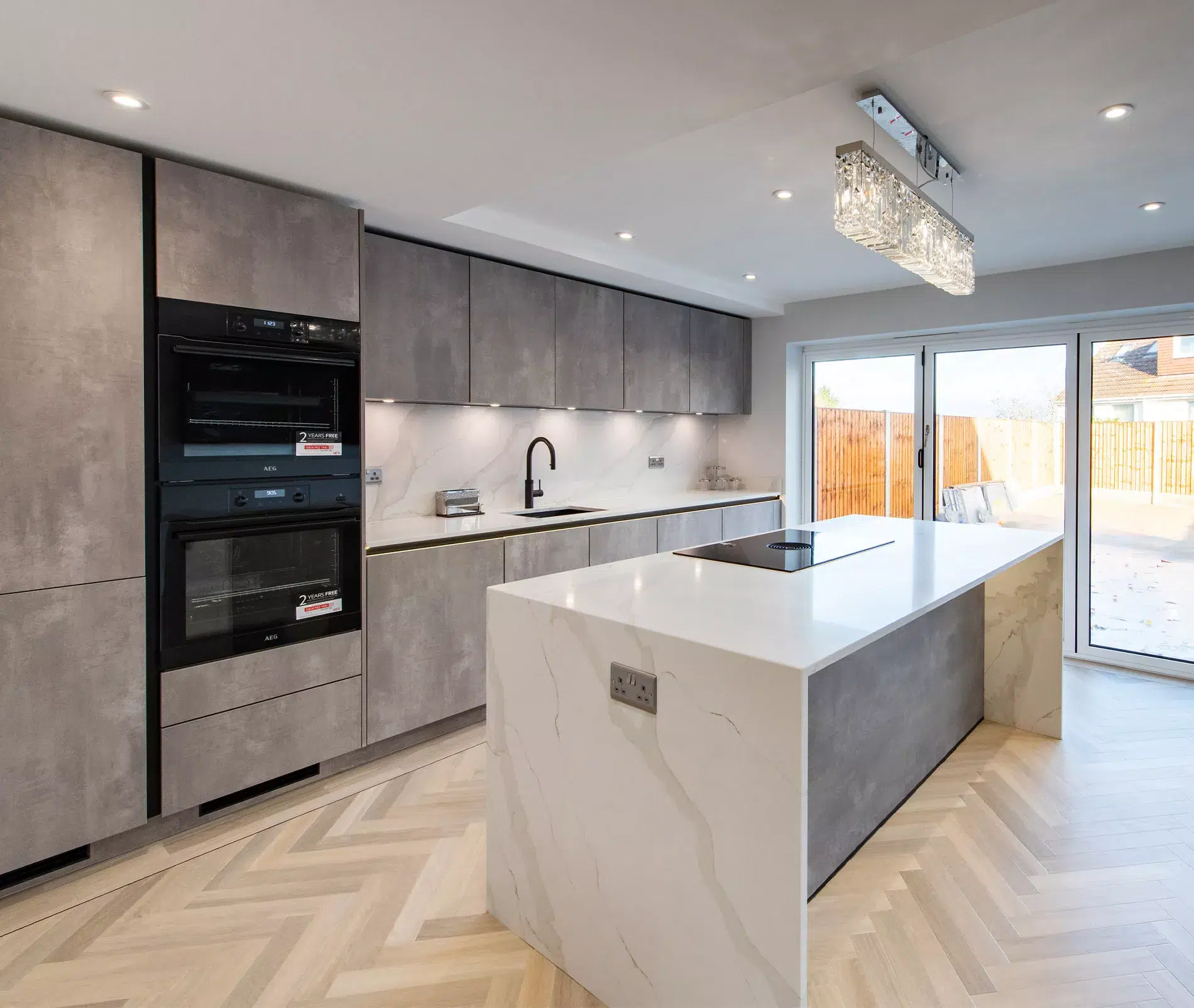
SOLID WOOD: CHARACTER WITH CONDITIONS
Solid timber worktops, particularly oak, walnut and iroko, bring a warmth and character to a kitchen that no engineered material can fully replicate. They work particularly well in traditional and painted kitchen schemes and suit period properties with real authenticity.
The trade-off is maintenance. Timber requires regular oiling to prevent drying, cracking and staining. It can be damaged by standing water if not dried promptly. It is not ideal for the area immediately around a sink, which is why many homeowners choose a stone or composite worktop around the sink and reserve timber for the island or a less wet section of the run. In a family kitchen with young children, timber requires a degree of care and attentiveness that some households find suits them and others do not.
PORCELAIN AND CERAMIC: THE GROWING ALTERNATIVE
Large-format porcelain slabs have grown significantly in popularity as a worktop material over the past few years. They offer excellent resistance to heat, scratching, staining and UV fading. They are available in very large formats that can span a run without visible joins, and the range of finishes now available, including very convincing stone, concrete and marble effects, is considerable.
The main considerations are brittleness at the edges, which requires careful fabrication and handling, and the fact that repair is very difficult if a chip or crack does occur. As a material it rewards quality installation from an experienced worktop fabricator.
DEKTON AND SINTERED STONE
Sintered stone surfaces such as Dekton and Neolith sit at the premium end of the engineered surface market. They are produced at extremely high temperatures and pressures, resulting in a material that is highly resistant to heat, UV, staining and scratching. Dekton in particular is a popular choice for kitchens with bifold or sliding doors to the garden, where the worktop continues outside or where UV exposure is a factor.
Cost is the primary consideration. These materials are among the most expensive worktop options available, and fabrication and installation requires specialist skills. For a kitchen renovation where longevity and performance are the priority, they represent a sound long-term investment.
WHICH MATERIAL IS RIGHT FOR YOUR FAMILY KITCHEN?
There is no single right answer. The best worktop for your kitchen depends on how your family uses the space, how much maintenance you are realistically willing to carry out, the overall design aesthetic you are working towards, and your budget. Our designers at Ornate Kitchens will guide you through the options during your design consultation, helping you arrive at a choice that serves your family well for years to come.
FREQUENTLY ASKED QUESTIONS
Which worktop material is the most durable for a family kitchen?
Engineered quartz and sintered stone surfaces such as Dekton offer the highest level of all-round durability for everyday family use. Both are non-porous, stain-resistant and very hard-wearing. Granite is also highly durable and adds the benefit of natural heat resistance.
Is solid wood practical in a kitchen with young children?
It can be, with the right approach to maintenance and use. Many families choose timber for an island or breakfast bar and use a more resilient material for the main run. Regular oiling and prompt attention to spills will keep a timber worktop in excellent condition.
Can quartz worktops be damaged by hot pans?
Yes. Quartz contains resin binders that can be damaged by extreme heat. Always use a trivet or pan stand rather than placing hot cookware directly on the surface.
What is the difference between quartz and sintered stone?
Quartz worktops are composed of crushed quartz bound with resin, which gives them excellent hardness and non-porosity but some vulnerability to heat. Sintered stone is produced at very high heat and pressure without resin binders, making it heat-proof and UV-stable, which is particularly useful for outdoor or exposed kitchen settings.
How do I choose between stone and wood for a traditional kitchen?
Many traditional kitchens combine both. A stone or quartz worktop on the main run provides durability and low maintenance, while a timber top on an island or peninsular adds warmth and character. This mixed approach is popular and works particularly well with painted and in-frame kitchen styles.